
swiss watch video.
Three constraints
nobody else has.
Hand position is fixed by the brand charter to the exact second, sapphire crystal reflects nearly twice as much light as ordinary glass, and depth of field collapses at the magnifications the work requires.
The time on the dial is not a creative decision
Watch imagery has shown 10:10 since the 1950s: the hands frame the logo, clear the sub-dials and draw a smile. What is less widely known is that every maison has its own exact value.
To the second. In stills, that is a matter of patience. On film it means the seconds hand must be stopped or driven for the full duration of the shot — a shooting constraint in its own right, decided in prep, never on set.
Sapphire reflects twice as much
Sapphire has a refractive index of roughly 1.77, against 1.50 for common mineral glass. Applying the Fresnel relation, that gives close to 7.7% reflection per interface, against 4%. Across two interfaces, an untreated crystal therefore throws back considerably more stray light. That is the physical reason anti-reflective coating exists — and why a piece without it turns a set into a contortion exercise.
Depth of field collapses
A case is 40 mm across. What gives it its value — the bevelling of a bridge, the grain of a sunray dial, the edge of a hand — measures between 0.05 and 2 mm. So we work between 1:1 and 5:1, where the effective aperture is no longer the one engraved on the barrel.
Stopping down destroys resolution through diffraction and costs two to five stops of light. The only ways out: tilt the plane of focus per Scheimpflug, stack focus frame by frame, or write the shot around a focus point that travels.
Filming a mechanical
movement.
The most common frequency is 28,800 vibrations per hour — 4 Hz, eight vibrations per second — though not a universal one: Omega Co-Axial calibres run at 25,200, several A. Lange & Söhne movements at 21,600, the Zenith El Primero at 36,000. To read the contact between escape wheel tooth and pallet stone you need around 1,000 frames per second, which divides exposure time by forty: forty times more light than a normal shot, a little over five stops — closer to six in practice, since a high-speed camera is less sensitive.
What each frame rate buys you
- 120 fps — the balance wheel is legible, the escapement is still a blur.
- 240 fps — around 30 frames per vibration: enough for amplitude and rhythm, not enough to freeze the impact.
- 1,000 fps — 125 frames per vibration. You see unlocking, impulse and drop. This is where the film stops illustrating and starts demonstrating.
A tourbillon, by contrast, turns once a minute. It isn’t filmed fast — it’s filmed sharp, and that is an entirely different problem.
Flicker, and why it kills a shot
Above 100 frames per second, how your sources are powered becomes a subject in itself.
- Tungsten — safe from 5 kW up thanks to filament inertia; run on DC it does not flicker at all.
- HMI — high-frequency ballasts at 300 Hz or 1,000 Hz, which allow up to 1,000 frames per second with no beat.
- LED — cinema fixtures do not flicker as long as you do not dim them. The culprit is pulse-width dimming. We control exposure with distance, diffusion and ND, never with the dimmer knob.
A constraint nobody mentions: heat
At 1,000 frames per second the exposure lasts one millisecond. The light output required generates heat — and a running movement is a thermally sensitive object: the oil, the balance amplitude and the expansions all react. On our sets that translates into high-efficiency cool sources, lights killed between takes, and a watchmaker on hand.
A path validated step by step, then replayed at full speed five millimetres from a CHF 200,000 piece.
Motion control is a risk management argument too
Motion control is
not a luxury.
Lighting that brings a sunray dial to life kills the sapphire crystal. Lighting that draws the mirror polish on a lug flattens the satin finish of the bracelet. There is no single lighting setup that does a watch justice.
- Lighting passes. One pass for the dial, one for the crystal, one for specular metal, one for the background, one for the flags. Recomposited, they produce an image no single setup can give. At 1:1, a two-tenths-of-a-millimetre discrepancy between two passes is visible.
- References. A campaign is never about one watch, but about a range: steel and gold, three dials, two bracelets. The same move replayed identically produces a strictly homogeneous library. That is where the machine pays for itself — not on the hero shot.
- Matching to 3D. Because the camera move is known numerically, there is no tracking to solve: the virtual camera is imported as is.
Light: you don’t light a watch,
you build what reflects in it
A polished surface has no colour of its own — it displays an image of its environment. Lighting a watch therefore means building the environment that will reflect in it, which is why a watch set holds more black card and diffusion than it does fixtures.
The gradient across a dial, that signature of the sector, comes from a large soft source placed very close, at a grazing angle, cut by a flag. Black is as active a tool as light. Cross-polarisation removes reflections, but pushed all the way it renders 18-carat gold dull and dead: we take it a few degrees off alignment.
And there is the least glamorous part of the craft. Budget half an hour to an hour of cleaning per piece before the first frame. Diffuse light is flattering but does not render material; direct light renders material — including dust and micro-scratches.
3D, and what only
a shoot can do.
An exploded view of a movement is almost always CGI, because you do not disassemble a running calibre on set. A watchmaker’s CAD file, however, is not a render-ready object.
CAD describes manufacturing geometry, not surface states. It contains neither the bevels, nor the polished chamfers, nor the real geometry of Côtes de Genève. Everything has to be re-modelled, then the materials built: anisotropic reflection oriented to the brushing direction for satin steel, a multi-layer material for a lacquered dial, a thin film with its colour shift for the AR coating, a measured complex index for gold.
The right split is simple: 3D for what is physically impossible — the explosion, the assembly, the cutaway. Live action for everything that has to inspire trust: real material, real light, the watchmaker’s hand.
Generative AI cannot display your charter’s time
Ask an image generator for a watch showing 2:45. It will produce 10:10. Its training data is saturated with that position, and the researchers who documented it admit they do not know how to correct it short of full retraining.
It is an amusing test, but it says something serious: a generative model guarantees neither the fidelity of a logo, nor the geometry of an applied index, nor a bezel engraving. Which is exactly what a maison cannot delegate.
The market has already ruled. In December 2025, an AI-generated video published by Valentino — clearly labelled as such — drew hundreds of hostile comments. Getty Images research shows consumers judge a generated image as less valuable, and that transparency is not enough to win them over.
We use it for scouting, storyboarding and versioning. Never for the final product image.
What it costs.
Between CHF 3,000 and CHF 30,000 depending on the setup. We publish these figures because a conversation that starts from a shared budget moves faster — and because no Swiss studio publishes its rates in this segment.
Amounts in Swiss francs, excluding media buying.
Below CHF 10,000, motion control does not fit
A robot with its operator alone costs between CHF 4,000 and CHF 5,000 per day in Switzerland. If the budget sits below that, we shoot differently — on a rostrum, with manual passes and more compositing. The result is different, and we show you the difference before we start rather than after.
These are not global campaign figures
An international campaign with a signature director and worldwide rights runs into hundreds of thousands of francs, and it will be produced by an agency in Geneva or Paris. We do the same technical work — the same macro, the same motion control, the same demands on metal and sapphire — without the structure that comes with it. That is our proposition, and we prefer to state it rather than let you guess.
A single thirty-second spot on SRF during the Euros costs CHF 70,000 to 95,000.
Three to five of our films — for one appearance on air
How we work
with a maison.
The deliverable of a watch campaign is never a film. It is a matrix: N references × M formats × K markets. It gets locked before the shoot, never after.
- Vertical is shot, not cropped. A 16:9 macro shot cropped to 9:16 loses the bracelet or cuts the case. Either the move is written for vertical with a 16:9 extraction, or we shoot two passes — which motion control makes almost free once the machine is set up.
- Pieces arrive insured and leave counted. Certificate of insurance before handover, secure transport, photographed inventory in and out. A representative of the maison is present whenever unreleased pieces are involved.
- The NDA is signed by the entire team, freelancers and post-production included. No personal phones on the product set, encrypted storage.
- A flawless piece costs less than a piece repaired in post. A scratch on a polished lug is not retouched once: it is retouched one hundred and twenty-five times for five seconds. And if it sits in a moving reflection, no tracking tool will propagate it. That is a line item, not an adjustment variable.
- Approvals take the time they take. Marketing, product, legal, management. We plan for three to five rounds and schedule them from prep, so they do not eat the release date.
- Swiss made is a legal commitment. Since 2017, the label requires at least 60% of manufacturing costs to be incurred in Switzerland. A manufacture film that suggests an origin commits the maison — which is why legal reviews the voice-over and the end cards.
Three watchmaking
projects.
What we shot, how, and why it was built that way. There are others, and there will be more — these three are enough to say what we mean.
Bellevue
A Swiss watch brand wanted packshots for its website, but filmed rather than photographed. Shot in studio on a motorised slider, with animated light and Canson paper backdrops cut and laid out as flat colour blocks.
The camera moves, the watch does not. That is what makes it read as a living photograph rather than a film — the three loops above come from this shoot.
Girard-Perregaux
A social campaign shot just after the last edition of the SIHH in Geneva. The fair became Watches & Wonders the following year.
Delivered as three vertical formats built for the feed. The opening shot of this page and the movement loops come from it.
Federation of the Swiss Watch Industry
A general film covering the whole range of the Federation’s activities, delivered in French, German and English.
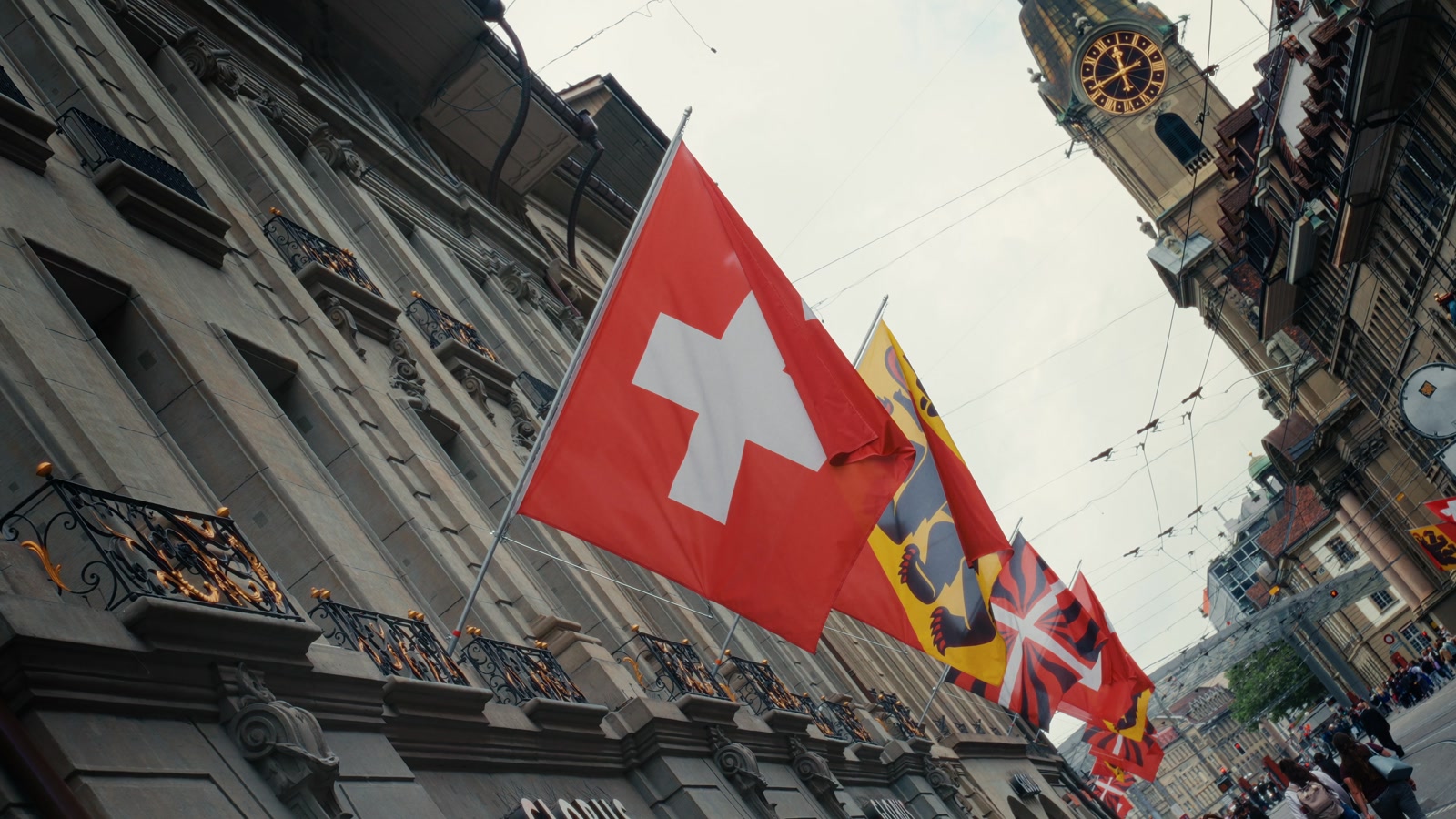
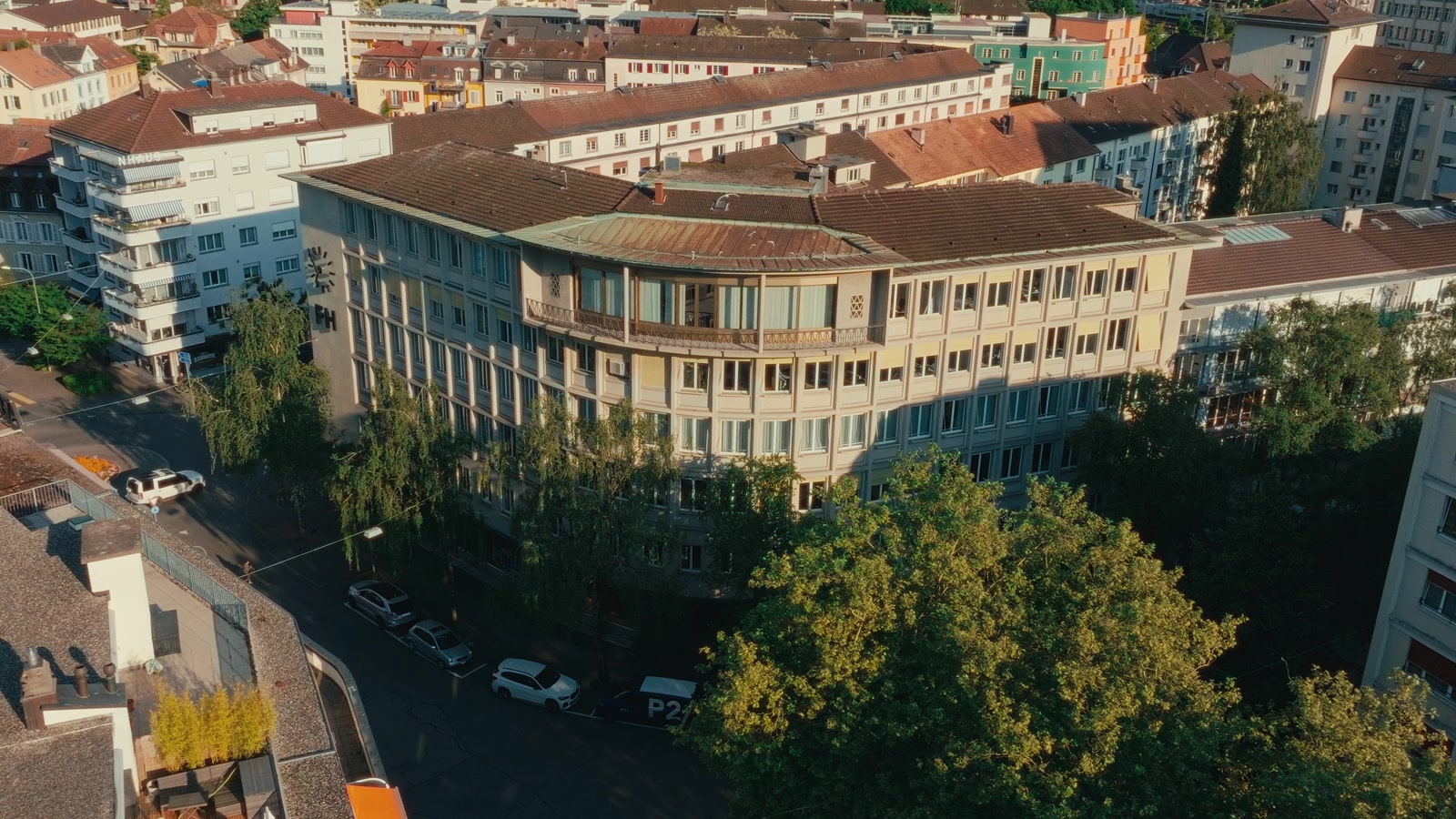
The views of Biel and the flags on this page are taken from it.
Frequently asked.
How much does a video for a watch brand cost in Switzerland?
At Klap Studio, between CHF 3,000 and CHF 30,000. An animated packshot of a single reference runs CHF 4,000 to 8,000, or CHF 10,000 to 20,000 with motion control. A product or brand content film runs CHF 8,000 to 18,000. A manufacture film runs CHF 12,000 to 30,000 and beyond depending on scope. A 3D exploded-view sequence runs CHF 6,000 to 15,000. Beyond that you enter international campaign territory, which runs into hundreds of thousands of francs and is produced by agencies.
What frame rate is needed to film an escapement?
Around 1,000 frames per second. A calibre at 28,800 vibrations per hour beats at 4 Hz, one vibration every 125 milliseconds; at 1,000 fps you get 125 frames per vibration, a ×40 slow motion. At 240 fps you can read balance amplitude but not the escapement contact.
Why is motion control necessary in watchmaking?
Because no single lighting setup does justice to the dial, the sapphire crystal and the polished metal at the same time. We shoot several passes with different lighting and recomposite them, which requires the camera to replay exactly the same move. It also lets us produce an entire range of references with a rigorously identical movement.
Can generative AI be used for a watch campaign?
Not for the product image. A generative model guarantees neither the hand position imposed by the brand charter, nor the fidelity of a logo, an applied index or an engraving. It is genuinely useful in preparation — scouting, storyboarding, previsualisation — and for versioning formats.
How long does a watch production take?
Allow two to four weeks of preparation, two to five shooting days depending on the number of references, and four to eight weeks of post-production including approval cycles. The real schedule is almost always dictated by a fair embargo.
Where are you based?
In Biel/Bienne, Rue du Marché 29, at the centre of the Swiss watchmaking arc. We work in French, German and English, throughout Switzerland and across Europe.
let’s talk about your next piece.


